By Stephanie Daniels (Abuja)
…says institutionalizing confidence key to sustaining Nigeria’s energy leadership in Africa
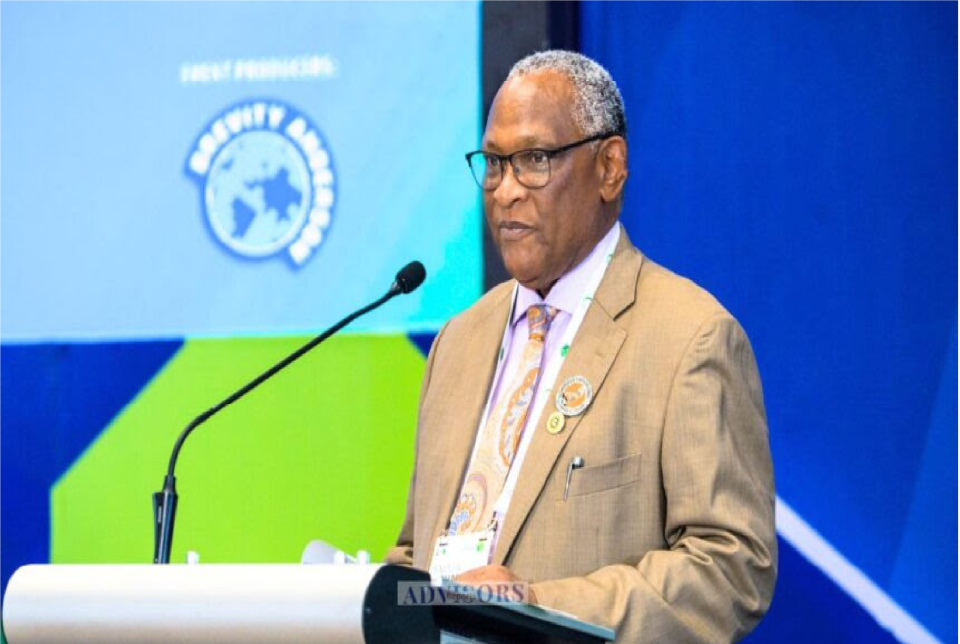
Engr. Saidu Mohammed, Chief Executive of the Nigerian Midstream and Downstream Petroleum Regulatory Authority (NMDPRA) says market confidence can’t be taken for granted as it is Nigeria’s most valuable energy currency, pointing out that credible institutions, consistent regulation, and respect for contract agreements are imperative to de-risking investment and unlock sustainable growth in the petroleum sector.
He said institutionalizing market confidence would enable Nigeria to sustain its leadership position in Africa’s evolving energy ecosystem.
The ACE stated this in his keynote address delivered on the topic, “Driving Nigeria’s Downstream Renaissance: Regulation, Investment, and Market Confidence,” at the just concluded Nigeria International Energy Summit (NIES) 2026, held at the International Conference Centre in Abuja.
He said: “Market confidence is urgently needed and can only be achieved through credible institutions and consistent regulatory actions.
“As regulators, we understand that our credibility is Nigeria’s credibility. Our task as regulators is to de-risk investment by ensuring fairness, transparency, consistency, optimal licensing and permitting, commercially viable frameworks, market transparency, and data integrity”.
He said that the NMDPRA would continue to uphold these values across the sector. Adding that “confidence is the true currency of any market. Investors commit where contracts are respected.
“Operators expand where rules are stable. Commercial agreements must be honoured. This is why we remain committed to professionalism, stakeholder engagement, and continuous improvement aligned with global best practices, while remaining grounded in Nigeria’s economic realities.
“Nigeria’s downstream readiness is not the responsibility of regulators alone. It is a shared project between government, investors, operators, financiers, and consumers”, Engr. Saidu Mohammed said.
He noted that the Authority’s role was to set the rules, enforce them fairly, and inspire confidence.
“Operators’ role is to invest, innovate, operate responsibly, and deliver value.”
Adding he said: “For decades, the downstream sector has been associated with negative outcomes: inadequate infrastructure, suboptimal supply chains, inefficiency, weak investment, poor regulatory compliance, and unacceptable levels of process and operational safety.
“That narrative is rapidly changing, and the sector is now witnessing drastic reform.
“The downstream market is becoming more driven by fundamentals and is attaining the stability required to attract investors.
“There can be no investment without stability.
“We are witnessing an irreversible renaissance, driven by bold reforms, investment, and regulatory clarity”.
He also disclosed that the country was on its move from near 100 percent importation toward zero importation, driven by local refining and improved domestic capacity. This was with the assurance that efforts would be made to keep the tempo so as to fully harness and improve the country’s hydrocarbon resources.
He described Dangote Petroleum Refinery as a major game changer, assuring that the Authority is dedicated to improving investment of that magnitude to guarantee products available.
“This is why we are creating room for the development of new refineries, including efforts to bring NNPC refineries back on stream”, he said.
He emphasized that Nigeria has significant potential to become self-sufficient and to extend supply beyond its borders to the West African sub-region and the entire continent.
“Our refineries — existing and new — have the capacity to enhance domestic supply, and this will continue to grow.
“Africa is a continent that needs energy before we can talk meaningfully about clean energy transition.
“We want all forms of energy available, including hydrocarbons, to address energy poverty. I am not advocating dirty energy, but rather cleaner energy, while using our resources to drive the ultimate goal of net zero”, he said.
Adding he said: “The cumulative impact of full deregulation of the downstream market and deeper gas utilization has significantly reduced petroleum importation and economic losses.
“Through local refining and reduced imports, Nigeria has gained about ₦6 trillion in just nine months of 2025.
“This is the way forward — conserving foreign exchange and ensuring market certainty.
“Let the energy sector be the builder of foreign exchange, not the avenue for eroding what we earn from crude oil exports”.
According to him, Nigeria’s gas sector is rapidly emerging as a major energy pillar for both the country and the wider region, stressing that government and industry must build a commercially driven gas ecosystem supported by optimal infrastructure, strong institutions, and clear market processes.
Adding that the “Decade of Gas” is more about funding, noting that Nigeria will add more value to gas, much more than just for transport or export ,
He added that the country has no justification for any failure to export urea, ammonia, and fertilizers to the global markets, thereby strengthening industrial development as well as broaden the economic base.
On regulation, the ACE stated that “infrastructure alone does not guarantee success,” stressing that refinery and midstream approvals must be based on economic viability and alignment with Nigeria’s domestic energy sufficiency goals, while insisting that higher regulatory standards are essential to protect consumers and ensure supply security.
He further said Nigeria’s downstream renaissance would depend heavily on private sector investment, explaining that government was repositioning pipeline networks around refinery hubs and enforcing payment discipline in gas offtake arrangements,
He noted that the reforms were aimed at building a fair, predictable, and competitive market capable of sustaining Nigeria’s leadership in Africa’s evolving energy ecosystem.