
By Abid Habib
This is a fact-based summary of the story contents on Delta Air, Abid Habib said, and then wrote.
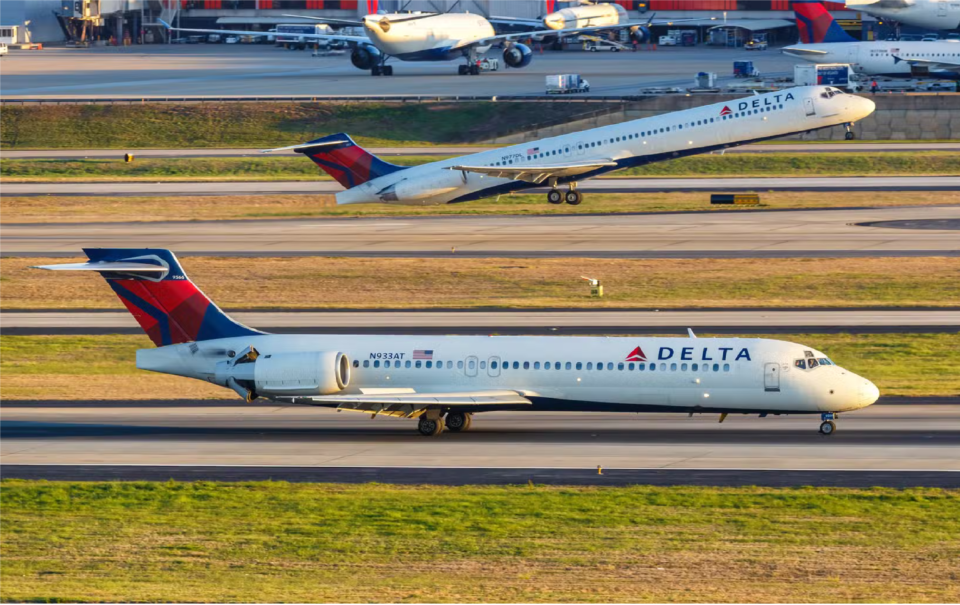
In a world where airlines are trying to be as efficient and economical as possible, carriers prefer to operate a fleet of new and modern aircraft, giving them the operational advantages newer jets have to offer, but also bragging rights about maintaining a young average fleet age. A possible exception to this could be the US-based carrier – Delta Air Lines, and its continual operation of the Boeing 717s.
It’s common to see carriers in the US operate older jets such as the Boeing 757s and 767s. However, when it comes to the 717s, it is just Delta and Hawaiian Airlines for the time being.
Delta Has Flown Its 717s for 14 Years
Having acquired 88 of these aircraft on a long-term lease from Southwest Airlines in 2012, Delta Air Lines has operated the Boeing 717 in the last 14 years. However, these aircraft are over 25 years old, and their fundamental designs do not originate with Boeing, but, rather McDonnel Douglas, and can be traced as far back as the DC-9 aircraft family from the 1960s. As such, they are neither new nor technologically advanced compared to the majority of the jets being flown today.
This is why, in recent years, the carrier has been reducing its 717 operations and therefore is in the process of replacing these jets with suitable modern aircraft, which can operate efficiently on regional and short-hop flights. While there are a number of options on the market, in this case, Delta has decided the suitable replacement will be the Airbus A220 aircraft family, which in itself has an interesting origin story.
While Delta first announced its plan to retire the 717s from service (among other aircraft types) in 2020, it is worth noting that the carrier had already started operating the A220s prior, having received the first example of the type in 2018 and deploying it in commercial service in 2019. While the carrier originally planned to retire the type this year, delivery delays with the A220s have resulted in the 717s continuing their operations.
As mentioned above, the Boeing 717 is related to the Douglas DC-9 which was designed in the early 1960s and had Delta as its launch customer in 1965. However, the manufacturer, Douglas Aircraft Company, merged with McDonnell Aircraft Corporation soon thereafter to form McDonnell Douglas. This resulted in the DC-9 being developed into the MD-80, which subsequently became the MD-90s by the early 1990s and eventually the MD-95.
However, when Boeing acquired McDonnell Douglas in 1997, it was left with the MD-95 in an era when it was focusing on its highly popular 737 program on the narrowbody side and the long-haul 777 program on the widebody side. As such, Boeing decided to rebrand the MD-95 into the Boeing 717 we know today. While over the decades, the aircraft went through several upgrades with each iteration, its fundamental building blocks and designs remained fairly similar.
In 2012, when Delta needed capacity and replacement for its aging fleet of older MD aircraft, the fleet of 717s became available when Southwest Airlines (now famous for its all-737 operations) took over AirTran, and wanted to get rid of the fleet of 717s the carrier flew. This enabled Delta to get these aircraft on long-term lease for an excellent deal. Since Delta was already operating the predecessors of the type, the airline was able to easily integrate the aircraft into its fleet.
Data from ch-aviation indicates that Delta currently operates 83 Airbus A220 family aircraft (45 units of the A220-100 variant, of which two are marked as inactive, and 38 of the larger A220-300 model, with two being inactive). Additionally, the carrier has another 62 A220-300 aircraft on order. Based on the way Delta has configured its aircraft, it is clear to identify why the A220 is a suitable replacement for the carrier’s outgoing fleet of 717s.
This demonstrates that the A220 is perfectly suited to replace the Boeing 717s when it comes to the capacity it can offer, but the additional range made available can offer Delta increased flexibility in how the aircraft is used and can also offer access to newer markets that are farther away but cannot sustain the capacity of larger Boeing 737 or Airbus A320 aircraft.
With the longer wings, newer and more efficient engines, newer airframe structures, and better technology, the A220 will offer improved operational advantages and better fuel economics for the airline, while offering a more comfortable travel experience for passengers. The reduced fuel burn also helps the carrier reduce its carbon footprint, which is a key aspect of the aviation business that airlines are scrutinizing these days and are actively trying to reduce.